On this page
curl -s https://jedarden.com/notes/benchmarks-measure-a-model-you-arent-running.md When a new model drops, the benchmark scores arrive first. SWE-bench Verified percentage. HumanEval pass@1. APPS accuracy. These numbers travel fast because they are precise and comparable — they feel like a specification sheet for a component you are about to buy.
What they actually measure is a very specific operating condition that most people are not running in. Understanding what that condition is changes how you interpret the score, and it changes which deployment model actually delivers the capability the score advertises.
What the context window looks like during a benchmark#
I measured the token count of every problem in the coding benchmarks that model launches cite today, and re-measured the set I first measured in May. The tokenizer is cl100k_base (GPT-4 / tiktoken); o200k_base medians land within a few tokens. The numbers are for the task as the benchmark hands it to the model — the issue, instruction, or problem statement — before any harness wraps it.
The current benchmarks (measured October 2026):
| Benchmark | Problems | Median | P99 | Max |
|---|---|---|---|---|
| Terminal-Bench 2.0 | 89 | 167 tokens | 907 | 1,148 |
| SWE-bench Multimodal (text only) | 480 | 252 tokens | 1,376 | 60,719 |
| Multi-SWE-bench | 1,632 | 307 tokens | 3,189 | 11,400 |
| SWE-PolyBench | 2,110 | 307 tokens | 2,528 | 16,222 |
| SWE-bench Multilingual | 300 | 374 tokens | 4,863 | 22,492 |
| Terminal-Bench 4.0 | 66 | 394 tokens | 1,494 | 1,972 |
| LiveCodeBench (release v6) | 1,055 | 416 tokens | 1,092 | 1,521 |
| Aider Polyglot | 225 | 434 tokens | 2,853 | 3,270 |
| DeepSWE | 113 | 439 tokens | 1,119 | 1,302 |
| SWE-rebench (2026 tasks) | 215 | 452 tokens | 6,561 | 15,154 |
| SWE-Lancer Diamond (IC tasks) | 198 | 653 tokens | 1,019 | 1,653 |
| SWE-bench Pro (V2, full instruction) | 642 | 707 tokens | 2,640 | 5,649 |
| SWE-Lancer Diamond (manager tasks) | 265 | 2,128 tokens | 5,297 | 7,610 |
The set I measured in May:
| Benchmark | Problems | Median | P99 | Max |
|---|---|---|---|---|
| MBPP | 257 | 16 tokens | 48 | 49 |
| HumanEval | 164 | 117 tokens | 310 | 391 |
| BigCodeBench | 1,140 | 129 tokens | 363 | 1,216 |
| SWE-bench Verified | 500 | 294 tokens | 2,514 | 6,939 |
| SWE-bench | 2,294 | 282 tokens | 2,937 | 22,483 |
| LiveCodeBench | 400 | 421 tokens | 1,105 | 1,521 |
| APPS | 5,000 | 456 tokens | 1,103 | 1,815 |
Re-running the May method in October reproduced SWE-bench Verified exactly, problem for problem. The newer benchmarks write longer task specifications — SWE-bench Pro’s requirements and interface sections more than double its issue text — but longer is still small. More than 99% of the problems in every benchmark fit under 8,000 tokens. The largest single problem in any of them, a SWE-bench Multimodal issue at 60,719 tokens of text, is 6% of the 1,000,000-token window Claude Code now runs its default model with. At the median, a Terminal-Bench 4.0 task uses 0.04% of that window. A HumanEval problem uses 0.01%.
Two of the benchmarks the latest Claude launch cites, FrontierCode and CursorBench, do not publish their tasks, so they could not be measured.
The model being benchmarked is operating with its context window essentially empty.
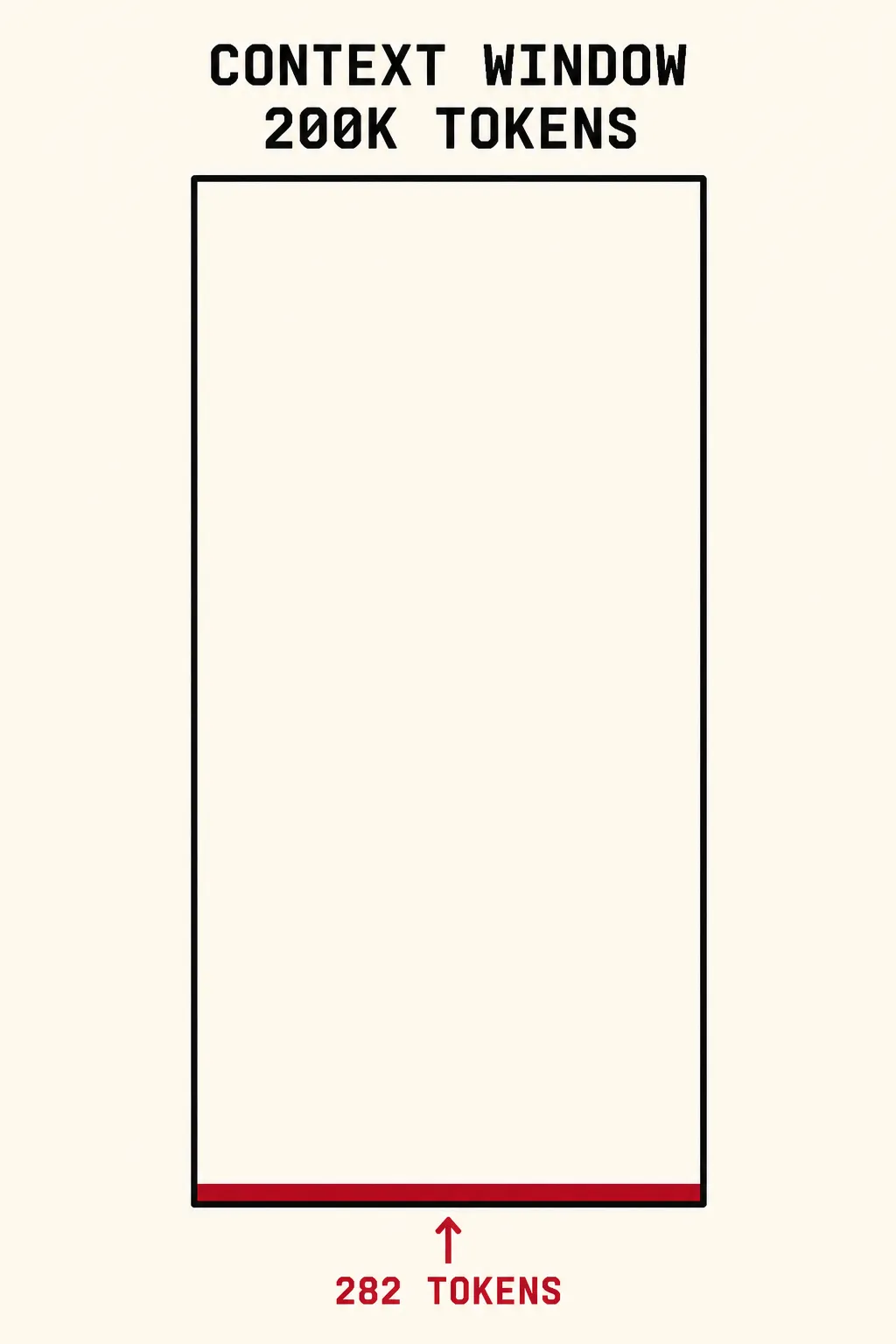
Two conditions, not one#
It is tempting to read “empty context window” as a capacity fact — the model has space available. The more important thing is what that space is not filled with.
A benchmark evaluation has two properties that travel together but are worth separating:
Few tokens of input. The problem statement is small. At 117 tokens, a HumanEval prompt is shorter than most Slack messages. The model has room to reason freely.
No prior turns. The context contains nothing except the problem. No corrections from three exchanges ago. No dead end the model went down and you had to redirect. No half-finished implementation that the model is tempted to continue in the wrong direction. No long system prompt from a previous session that is now only partially relevant. The model starts with a blank slate.
The second condition is the one that matters more, and it is the one people talk about least.
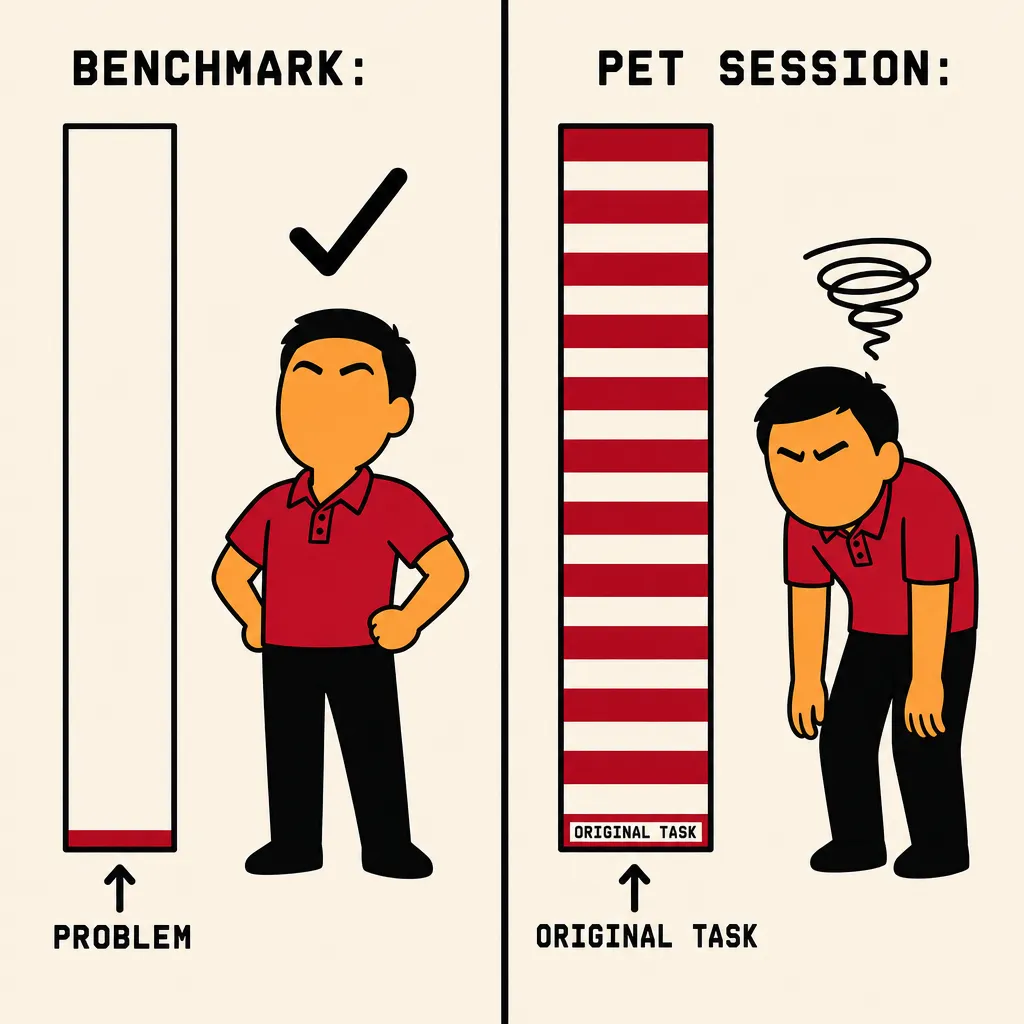
What fills a pet session’s context#
A pet agent session accumulates context continuously. After an hour of work, the context window contains:
- The original task description (probably underspecified)
- Your first few corrections and clarifications
- The model’s first attempt, which missed something
- Your redirect
- The model’s second attempt, partially correct
- More corrections
- Tool call outputs — file reads, test runs, error messages
- The model’s current understanding, shaped by all of the above
This is not neutral. Research on context window utilization shows that models degrade when relevant content is buried in earlier positions — the “lost in the middle” phenomenon. Information at the start and end of a context is attended to more reliably than information in the middle. A long pet session buries its most important content (the actual task requirements) under layers of accumulated back-and-forth.
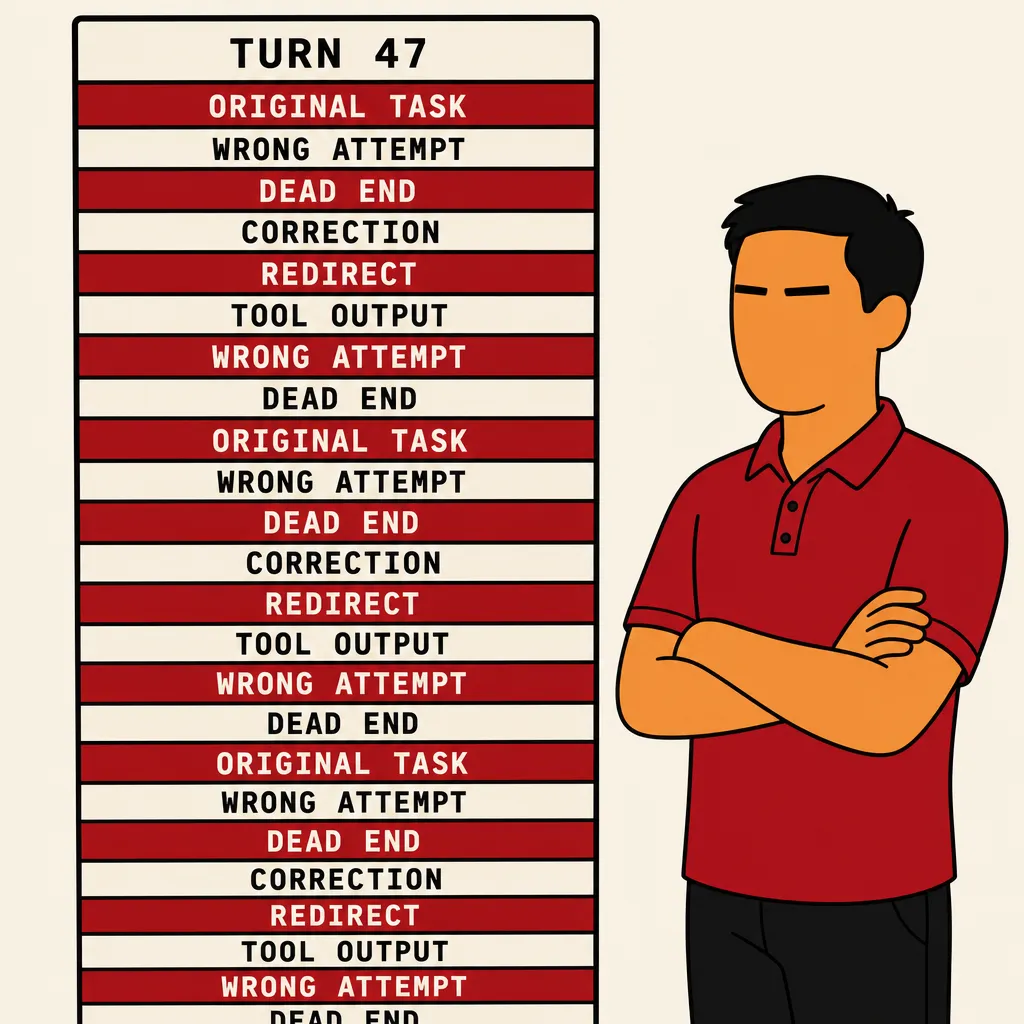
Beyond attention degradation, there is a more direct effect: the model’s prior wrong attempts are in the context. It has seen itself go down a particular path. It has a prior. That prior shapes the next attempt, not always in the right direction.
The benchmark model has none of this. It sees the problem cold. Whatever capability it has for that problem is expressed fully, without interference.
The cattle worker is the benchmark condition#
A stateless cattle worker dispatched by an orchestrator starts each task with a context containing:
- The project instructions (
CLAUDE.md) — stable, curated, written once - The task body from the bead — a precise specification of one unit of work
- Whatever reference material the task body explicitly includes
That is structurally close to a benchmark evaluation. The input is small and deliberate. There is no accumulated conversation. No prior wrong attempts. No corrections that anchored the model toward a direction it should abandon.
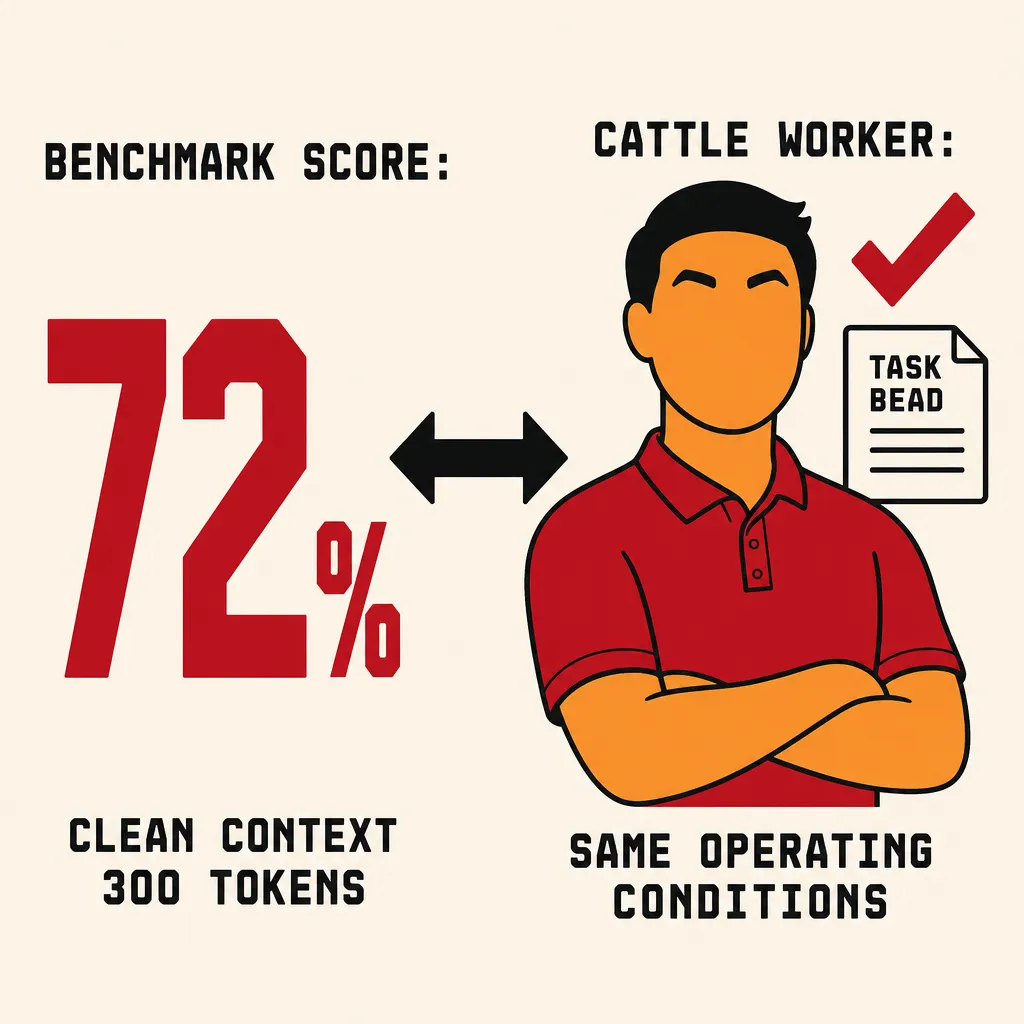
The pet session is not that model. The pet session is a model operating under conditions that are systematically worse than the conditions under which it was benchmarked — and those conditions degrade further the longer the session runs.
This means benchmark scores are a better predictor of cattle performance than pet performance. When you read that a model scores X% on SWE-bench Verified, the deployment model that will actually realize that capability is a stateless worker with a clean context and a well-scoped task — not an ongoing chat session where the model has been talking to you for two hours.
The score you are buying is not what you are running#
The practical consequence is that most people buy capability — a higher benchmark score, a more expensive model tier — and then run it in a mode that systematically degrades that capability below what the benchmark measured.
A pet session with a more capable model is better than a pet session with a less capable model, but both are operating below their benchmark-measured ceiling. The gap between “what the benchmark measured” and “what the pet session delivers” grows as the session accumulates context. By hour three, with 50,000 tokens of back-and-forth, you are running a noticeably different model than the one that got the score.
There is no equivalent degradation in the cattle model. A stateless worker dispatched against a well-specified task is as close to benchmark conditions as production use gets. The score is what you bought. The score is roughly what you run.
This also changes the economics of model selection. The correct question is not “which model scores highest on SWE-bench?” but “which model scores highest on SWE-bench, and am I running it in conditions that will actually realize that score?” If you are running pet sessions, you are paying for capability you are not fully using. If you are running cattle workers with clean contexts and scoped tasks, you are.
What an honest benchmark would measure#
The benchmarks that exist were designed for a world of clean evaluations, not for the question of how model capability degrades across a production conversation. None of them measure:
- Performance at turn 30 of a live session versus turn 1
- Performance with 80K tokens of prior context versus 500
- How much capability is recovered by compressing and distilling the context versus starting fresh
These would be more diagnostic for real production use. The existing benchmarks tell you the ceiling. What is missing is the curve that describes how quickly you fall away from that ceiling as the context accumulates, and how different deployment models (cattle versus pet) track that curve differently.
Until those measurements exist, the empirical data points in one direction: the deployment model closest to benchmark conditions is stateless dispatch into clean context. That is the cattle model.
The question I now ask#
When someone cites a benchmark to justify a model choice, I ask:
Under what context conditions was that score measured, and are those the conditions we are actually running?
If the answer is “a 300-token prompt against a blank context window” and the deployment is “an ongoing chat session that has been running for six hours,” the score is describing a model that is not the model they are running.
Knowing that does not mean you stop using pet sessions — there are tasks where they are the right tool, and where the accumulated context is a feature rather than a bug. It means you understand that benchmark scores are ceiling measurements, and that the delta between the ceiling and what you actually get is a function of the deployment model you chose.
Cattle closes that delta. That is the case, made empirically.
— Jed
Data: token counts measured across 9,755 benchmark problems in May 2026 (HumanEval, MBPP, SWE-bench, SWE-bench Verified, LiveCodeBench, BigCodeBench, APPS) and 8,035 more across thirteen benchmarks in October 2026 (the current set above, with SWE-rebench’s full snapshot of 860 tasks; SWE-bench Verified re-measured as a control), using the cl100k_base tokenizer. Raw data (per-problem token counts + full statistics, plus sources, revisions and fields in the October file): benchmark-tokens.json (May) and benchmark-tokens-2026-10.json (October) — schema, license, and citation on the data page. Background: pet agents vs. cattle agents — the deployment model this post argues for. The context reconstruction approach that makes clean-context cattle work: the plan is the prompt.